Financial domination doesn’t exist in isolation. For many submissives, it’s intertwined with other forms of power exchange, and one of the most common combinations is financial domination paired with humiliation.
The submissive doesn’t just send money—they’re mocked for it. Called pathetic. Told they’re a walking ATM, a human wallet, nothing but a source of funds. Their financial submission becomes a reason for degradation rather than praise.
For people unfamiliar with kink dynamics, this combination can be confusing. Why would someone want to be humiliated for giving their money away? Isn’t the giving enough? Why add degradation to the equation?
COMPANION STORY: “Worthless”
Experience this dynamic through fiction before diving into the psychology.
Read the story →This article explores why humiliation and financial domination pair so naturally for some submissives, what psychological needs this combination serves, how the two dynamics amplify each other, and how to engage with financial humiliation in ways that are satisfying rather than genuinely damaging.
Two Forms of Submission
To understand why these dynamics combine, it helps to understand what each provides on its own.
Financial domination is about material submission. You’re giving something concrete—money—that represents your time, labor, choices, security. The submission is tangible. Measurable. Real in a way that can’t be disputed.
Humiliation is about psychological submission. You’re being degraded, mocked, treated as less-than. Your ego is being attacked. Your sense of worth is being undermined. The submission is emotional and psychological rather than material.
When you combine them, you get submission that operates on multiple levels simultaneously. You’re giving materially and being degraded psychologically. Your wallet is drained and your ego is crushed. The submission is total—financial, emotional, psychological.
For submissives who need their submission to feel complete, this combination provides something that either dynamic alone doesn’t fully satisfy.
The Psychology of Humiliation in Kink
Before we talk about why humiliation pairs with financial domination specifically, it’s worth understanding why anyone seeks humiliation at all.
Humiliation in kink serves several psychological functions:
- It creates intense vulnerability. Being humiliated requires exposing yourself emotionally. You’re letting someone see you in ways that society says you shouldn’t be seen—as pathetic, weak, shameful. That exposure creates intimacy through vulnerability.
- It provides relief from ego. Many people carry the weight of maintaining their ego constantly—appearing confident, competent, worthy. Humiliation temporarily destroys that ego, which can feel like relief. You don’t have to maintain the performance anymore. Someone is explicitly telling you that you’re not those things.
- It’s transgressive. Society teaches us to protect our dignity, maintain our self-respect, never let anyone treat us as less-than. Consensual humiliation violates all of those rules. For people drawn to transgression, that violation is part of the appeal.
- It transforms shame into arousal. Many people carry shame—about desires, about needs, about aspects of themselves. Humiliation takes that shame and, in a consensual context, makes it erotic. The shame is still there, but it’s been transformed from something that diminishes you into something that intensifies your arousal and submission.
- It proves the power dynamic is real. Anyone can say they’re submitting. Being humiliated—actually degraded, mocked, treated as lesser—provides proof that the power dynamic isn’t just performance. The dominant genuinely sees you as beneath them, and they’re willing to express that.
These functions exist in humiliation generally. When you add financial domination to the mix, they take on specific flavors.
Why Humiliation Intensifies Financial Submission
When humiliation is added to financial domination, several things happen psychologically:
The tribute becomes a source of degradation rather than pride. In financial domination without humiliation, sending a tribute often comes with acknowledgment or even praise. “Good boy.” “Well done.” The tribute proves your worth as a submissive.
In financial domination with humiliation, the tribute proves your worthlessness. You just sent money and you’re being mocked for it. Called pathetic for giving. Told you’re nothing but a wallet. The act that should earn praise instead earns degradation.
This inversion is powerful for submissives who are drawn to it. The tribute costs you money and costs you dignity. The submission is doubled.

Your financial situation becomes ammunition. Without humiliation, your income or financial capacity is neutral information. You can afford to tribute, so you tribute.
With humiliation, your financial situation becomes a target. If you’re wealthy, you’re mocked for being a rich pay pig who can’t even manage to be useful with all that money. If you’re not wealthy, you’re mocked for being so pathetic that you’re giving away money you probably need. Either way, the financial reality becomes a reason to degrade you.
The power imbalance is made explicit. Financial domination already has a power imbalance—the dominant controls, the submissive gives. But that imbalance can be maintained with a certain amount of respect or acknowledgment.
Humiliation removes any pretense of respect. The dominant isn’t polite about the power they hold. They’re explicit: you’re beneath them. Your money is owed. You exist to be used. There’s no sugar-coating, no politeness, no acknowledgment of your humanity beyond your utility as a source of funds.
For submissives who need the power dynamic to feel stark and unambiguous, this explicitness is essential.
Shame is transformed into submission. Many people feel shame about financial submission—shame about giving money away, shame about wanting to be controlled financially, shame about finding this compelling.
Humiliation takes that shame and makes it part of the experience rather than a byproduct of it. You’re not ashamed despite the kink; you’re being actively shamed as part of the kink. The shame becomes incorporated into the erotic structure rather than being something you have to manage separately.
The Appeal of Being Treated as an Object
Financial humiliation often involves being reduced to your function: you’re not a person, you’re a wallet. A human ATM. A pay pig. A cash cow.
This objectification—being treated as a thing rather than a person—has specific appeal in the context of financial domination:
- It removes complexity. People are complicated. They have needs, feelings, histories, inner lives. Being treated as an object removes all of that. You’re just a source of money. Your inner life is irrelevant. Your feelings don’t matter beyond whether they make you send more. For someone whose regular life involves managing complexity constantly—relationships, career, obligations—being reduced to a single function can feel like relief. You don’t have to be a full person. You just have to perform one role: provide funds.
- It makes the submission feel total. If you’re still being treated as a person—someone with agency, dignity, rights—there’s a limit to how submissive you can feel. You’re giving, but you’re still human in the dynamic. Being treated as an object pushes past that limit. You’re not a person who chooses to give. You’re a thing that exists to be extracted from. The submission is complete because you’ve been conceptually erased as a human and redefined as a resource.
- It validates the feeling of being used. Many financial submissives describe wanting to feel used. Not just useful—actually used, the way you’d use a tool or a resource without particular care for the tool itself. Humiliation provides that feeling explicitly. The dominant isn’t grateful. They’re not acknowledging your sacrifice. They’re just using you and, in many cases, expressing contempt for you while doing so.
That lack of acknowledgment, that treatment as disposable resource, is what makes some submissives feel like the dynamic is real.
Financial Inadequacy as Humiliation
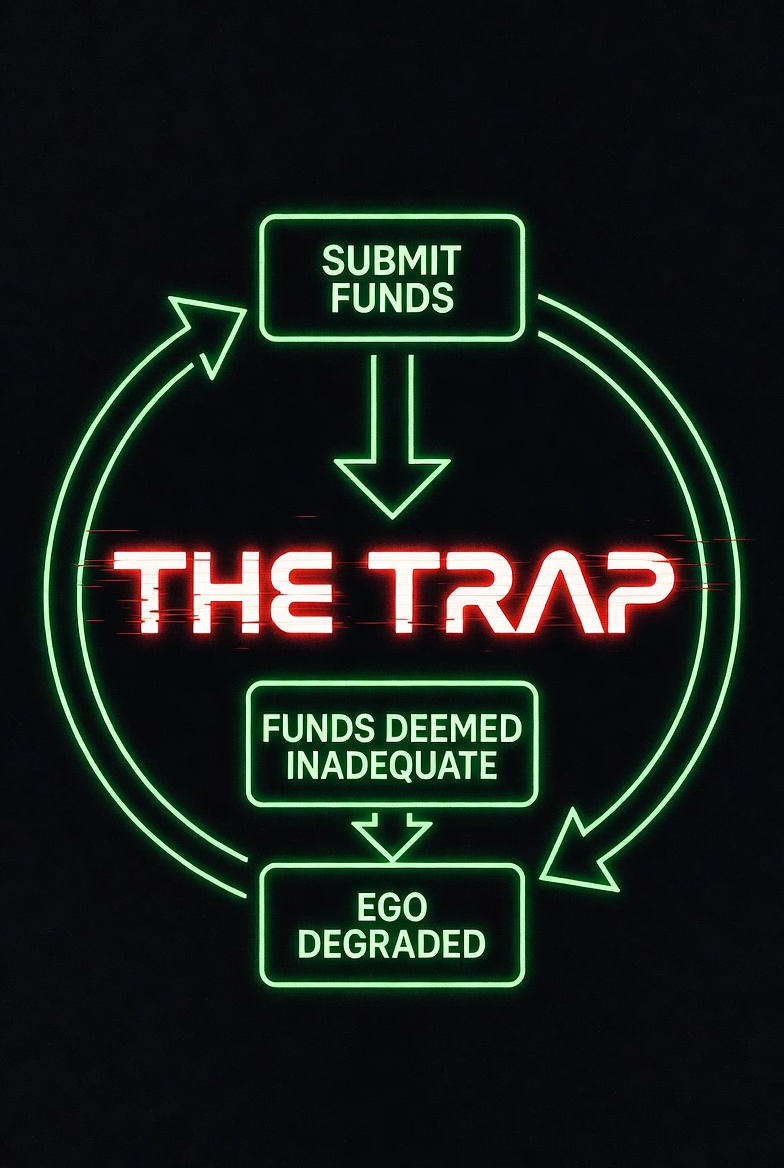
One specific form of financial humiliation involves being mocked for not giving enough.
You send a tribute and instead of acknowledgment, you get: “That’s it? That’s pathetic. I thought you were serious about this.” Or: “I spend more than that on coffee. Send something that actually matters.”
This form of humiliation is psychologically complex because it creates a double bind:
- If you send more to avoid the humiliation, you’re being controlled by the desire to please. The mockery has worked—it’s pushed you to escalate.
- If you don’t send more, the humiliation continues or intensifies. You’re confirmed as inadequate, pathetic, not worth the dominant’s time.
For submissives drawn to this, the double bind is part of the appeal. There’s no winning. No amount is ever quite enough. The humiliation is inescapable, which makes the power dynamic feel absolute.
But this is also where financial humiliation can become genuinely harmful if not managed carefully. The push to send more to avoid inadequacy can lead to sending amounts you genuinely can’t afford, driven not by desire but by the psychological need to escape the shame of being seen as insufficient.
The Role of Shame Transformation
Many people who seek financial humiliation are working with pre-existing shame.
- Shame about having money (if they’re high earners who feel guilt about wealth).
- Shame about wanting to submit financially (because it violates norms about masculinity, responsibility, rationality).
- Shame about being attracted to men (if they’re closeted or questioning).
- Shame about sexual desires generally (if they come from backgrounds that created sexual shame).
Financial humiliation doesn’t create this shame—it transforms it.
In regular life, shame is something you try to hide. It diminishes you. You manage it, suppress it, work around it.
In consensual humiliation, shame becomes part of the erotic structure. You’re not trying to hide it—you’re exposing it, and having it acknowledged and intensified by someone in a position of power over you.
This transformation does something psychologically interesting: it makes the shame conscious and contained rather than unconscious and diffuse.
The shame is still there, but now it has a specific place—in this dynamic, with this person, in this context. It’s not poisoning your whole life. It’s been channeled into something that’s both intense and boundaried.
Types of Financial Humiliation
Financial humiliation isn’t monolithic. It takes different forms depending on what specifically is being mocked or degraded:
- Amount-based humiliation: “That’s all you can afford? Pathetic.” Mockery focused on the tribute being insufficient, small, not worth attention.
- Comparison humiliation: “My other subs send more than this.” Being compared unfavorably to others, told you’re at the bottom of the hierarchy.
- Purpose-based humiliation: “You’re nothing but a wallet.” Your only value is financial. Being reduced to your function, told your personhood is irrelevant.
- Financial situation humiliation: “You should be giving more with your income.” Your actual financial circumstances becoming a source of mockery.
- Sacrifice-based humiliation: “Good, go without. You don’t need that. Send it to me instead.” Being mocked for the things you give up in order to tribute.
- Gratitude-denial humiliation: The dominant never thanks you, never acknowledges the tribute as a gift, treats it as owed.
Different submissives are drawn to different types. Some want to be mocked for insufficiency. Others want to be mocked for being wealthy and still submitting. Understanding what specific flavor of financial humiliation resonates with you helps you communicate what you’re actually seeking.
When Humiliation Crosses into Harm
Humiliation in kink exists in a delicate space between intense experience and genuine damage.
The goal is to feel humiliated—to experience shame, degradation, mockery—without that experience crossing into actual harm to your self-worth or psychological wellbeing. That line is different for everyone, and it can shift depending on your mental state.
Here are signs that financial humiliation has crossed from consensual kink into genuine psychological harm:
- It affects your self-worth outside the dynamic. The humiliation isn’t contained to sessions anymore. You genuinely believe you’re worthless, pathetic, only valuable for money.
- You can’t disengage from the shame. After a session, you should be able to return to baseline. If the shame and humiliation stay with you constantly, making you feel small and worthless in all areas of your life, that’s harm.
- It’s driving financially destructive behavior. You’re sending amounts you can’t afford specifically to avoid the humiliation of being called inadequate. The mockery has become a genuine fear controlling your behavior.
- You’ve lost the ability to advocate for yourself. In healthy humiliation dynamics, you can still express limits, use safewords, say “this isn’t working for me.” If you feel like you have no right to boundaries, the dynamic has become abusive.
- Your mental health is deteriorating. Increased depression, anxiety, or destabilization that’s clearly connected to the financial humiliation.
If you’re experiencing these signs, the dynamic has stopped being consensual kink and started being genuine psychological abuse, even if it started as consensual play.
The Importance of Aftercare
Humiliation—especially intense humiliation combined with financial submission—requires aftercare.
Aftercare is the transition period after a scene where you move from the intense experience back to baseline. It’s where the dominant acknowledges that the humiliation was consensual play, that you’re valued, that the degradation was part of a scene and doesn’t reflect your actual worth.
In financial domination with humiliation, aftercare might look like:
- Acknowledgment: The dominant explicitly states that the mockery was part of the dynamic, not their actual assessment of you.
- Reassurance: They confirm that you did well, that they value your submission, that you matter beyond just your wallet.
- Check-in: They ask how you’re feeling, whether the intensity was right, whether anything crossed a line.
- Transition: They help you move from submissive headspace back to regular functioning—ending the scene clearly rather than leaving you in degraded headspace indefinitely.

Not all financial domination dynamics include aftercare—some doms don’t provide it, some subs don’t want it. But for humiliation specifically, aftercare significantly reduces the risk of the experience causing lasting psychological harm.
Finding the Right Dominant for Financial Humiliation
Not all financial dominants incorporate humiliation, and not all dominants who do humiliation are good at it.
Financial humiliation requires skill:
- Understanding the line between scene and reality. A good dom knows the degradation is play. They’re performing contempt, not genuinely feeling it.
- Calibrating intensity. They push hard enough that you feel genuinely humiliated, but not so hard that they cause lasting damage. They read your responses and adjust.
- Providing structure. Clear beginnings and endings to scenes. Aftercare. Communication about limits.
- Respecting boundaries even while mocking you for having them. This is subtle but important. They can mock you within the scene (“Look at you, needing limits”), but they actually respect those limits. The mockery is part of the play; the respect is real.
If you’re seeking financial humiliation, look for dominants who have experience with humiliation play specifically, can articulate the difference between scene degradation and genuine contempt, are willing to discuss limits and aftercare, and show evidence of caring about submissives’ wellbeing even while degrading them.
Why Some Subs Don’t Want Humiliation
Just as some submissives need humiliation alongside financial domination, many don’t want it at all.
They want to give financially and be acknowledged for it—praised, valued, treated with respect even within the power dynamic. The submission is about service, generosity, devotion. Humiliation would undermine what makes the dynamic satisfying.
This is equally valid.
Financial domination doesn’t require humiliation. Some of the most intense, meaningful financial submission dynamics involve no degradation at all—just power exchange expressed through financial control. If humiliation doesn’t appeal to you, you don’t need to incorporate it.
Understanding Your Own Relationship to Shame
If you are drawn to financial humiliation, it’s worth examining your relationship to shame. Ask yourself:
- Is the humiliation transforming existing shame or creating new shame? If it’s transforming shame you already carry, that can be healthy. If it’s creating new shame that didn’t exist before, that’s more concerning.
- Can you disengage from the humiliation after scenes? If you can step out of it and return to a baseline, you’re managing it well.
- Does the humiliation serve you or harm you? Does it make your life better in some way, or does it destabilize your sense of worth?
- What would happen if you stopped? Would you miss the experience but be fundamentally okay? Or would you feel intense anxiety, loss, or destabilization?
These questions aren’t about judging whether you should engage with financial humiliation. They’re about helping you understand whether the way you’re engaging with it is sustainable and psychologically healthy.
The Compound Effect
When financial domination and humiliation combine, they create a compound effect where each dynamic intensifies the other.
The financial submission makes the humiliation feel more real—you’re not just being called pathetic, you’re being called pathetic while actively proving it by sending money. The humiliation makes the financial submission feel more intense—you’re not just giving, you’re giving and being degraded for it, which doubles the submission.
For submissives who need that compound intensity—who find that either dynamic alone doesn’t quite reach the psychological depth they’re seeking—the combination provides something neither dynamic can provide on its own.
It’s submission that operates on every level: material, psychological, emotional. You’re depleted financially and degraded psychologically. Nothing is held back.
That totality is what makes the combination compelling. But that same totality is also why it requires more care, more awareness, more structure than either dynamic alone.
Because the goal isn’t just to feel humiliated.
It’s to feel humiliated in ways that serve you, within structures that protect you, with people who understand the difference between degrading you in scene and genuinely harming you.