If you’ve spent any time in financial domination as a submissive, you’ve probably noticed something: the tributes you send when you’re aroused—particularly when you’re edging—are different from the ones you send in other states. Larger. More impulsive. Less calculated. And if you’re like most financial submissives, you’ve probably wondered why that is, whether it’s something you should lean into, and what it means for your practice.
COMPANION STORY: “The Session”
Experience this dynamic through fiction before diving into the psychology.
Read the story →This article explores the real psychological connection between sexual arousal, denial, and financial submission. Not as manipulation, but as honest inquiry into what’s actually happening in your brain and body when these two powerful drives intersect.
The Neuroscience of Arousal and Decision-Making
Let’s start with what we know about arousal and the brain.
When you’re sexually aroused—and especially when you’re edging, maintaining high arousal without release—your brain is flooded with dopamine. Dopamine is the neurotransmitter associated with reward, motivation, and pleasure-seeking behavior. It’s what makes you feel good when you anticipate something you want, and it’s a major driver of compulsive behavior.
Here’s where it gets interesting for financial submission: dopamine doesn’t distinguish between different kinds of rewards. Your brain’s reward circuitry treats sexual pleasure, the thrill of submission, and the act of giving money to someone you’re psychologically invested in as overlapping experiences. They all light up similar pathways.
When you’re edging, you’re essentially keeping your dopamine system in a sustained state of anticipation. You want release, but you’re deliberately denying it to yourself. That denial doesn’t make the wanting go away—it intensifies it. And in that intensified state, other reward-seeking behaviors become more appealing.
Including sending tributes.
The Psychological Loop
There’s a reason financial domination and edging pair so naturally: they’re both fundamentally about control and denial.
When you edge, you’re exercising control over your own pleasure—or, more accurately, you’re surrendering that control to a dominant who instructs you when (or if) you’re allowed to finish. The arousal builds. The wanting builds. And in that heightened state, the act of sending money becomes a form of release in itself.
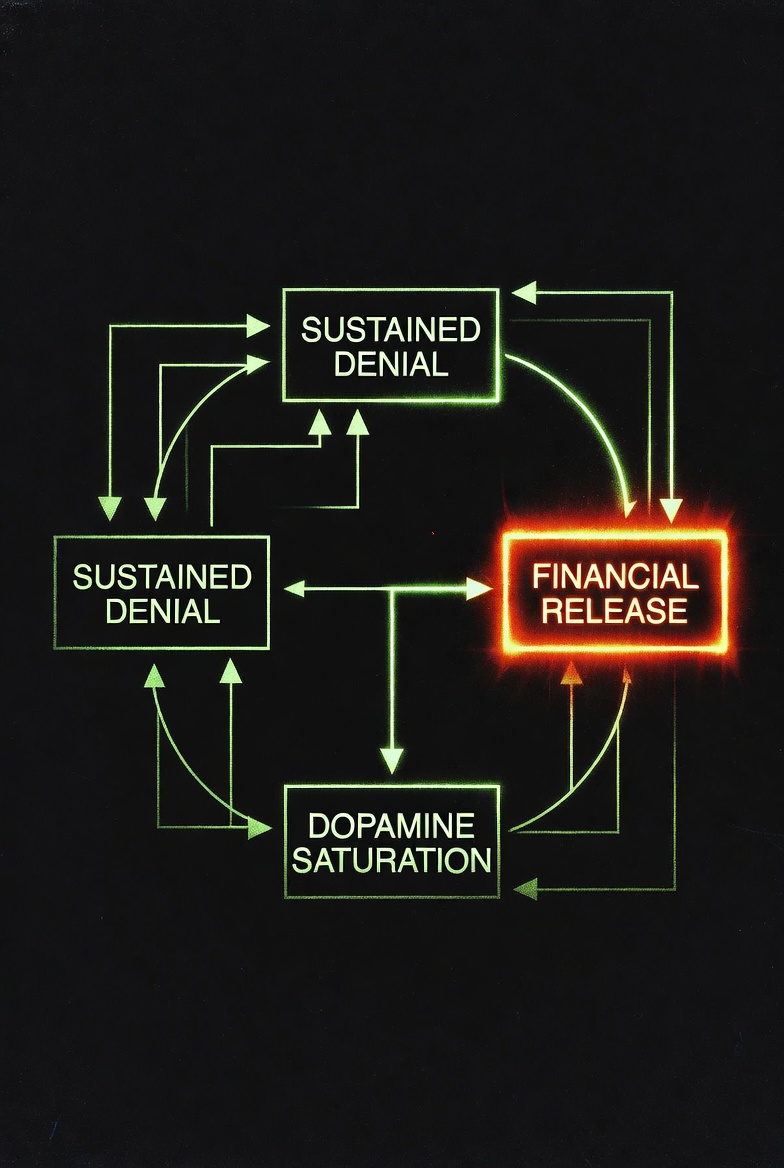
Not sexual release—you’re still edging, still denied—but psychological release. The tribute is a valve. It lets some of the pressure out. You send $50, $100, $200, and for a moment the loop completes: you wanted to give, you gave, you feel the particular satisfaction of having pleased your dom and submitted in a material way.
Then the arousal builds again. And the cycle continues.
This is why edging sessions often result in multiple tributes rather than one large one. Each tribute provides a small hit of satisfaction—enough to sustain the arousal, not enough to fully resolve it. You’re chasing a feeling that stays just out of reach, and the tributes become part of the chase.
Impaired Judgment or Clarified Desire?
Here’s where it gets complicated.
The standard narrative around arousal and decision-making is that sexual arousal impairs judgment. Studies show that people in heightened states of arousal make riskier decisions, discount future consequences, and prioritize immediate gratification. From this perspective, tributes sent while edging are “bad decisions”—things you’ll regret when you come down from the high.
And sometimes that’s true. If you’re sending money you can’t afford, or tributing in ways that violate boundaries you set for yourself in clearer states, then yes—the arousal is impairing your judgment and you should take that seriously.
But there’s another way to look at it.
For many financial submissives, arousal doesn’t create a desire that wasn’t there—it reveals a desire that’s always there but usually suppressed. In your baseline state, you’re busy being a responsible adult. You have a budget. You have plans. You have the full weight of social conditioning telling you that giving your money away to someone who demands it is irrational.
Arousal turns down the volume on all of that. It lets you access what you actually want, stripped of the performance of rationality.
The tributes you send while edging might not be impaired decisions. They might be clarified ones.
Why Edging Specifically
You might wonder: why edging? Why not just arousal in general?
The answer is duration and intensity.
A quick session—arousal, climax, done—doesn’t give the psychological loop time to develop. You’re aroused, you finish, the dopamine spike resolves, and you return to baseline. There’s not enough sustained time in the heightened state for the financial submission to fully integrate with the sexual arousal.
You might wonder: why edging? Why not just arousal in general?
The answer is duration and intensity.
A quick session—arousal, climax, done—doesn’t give the psychological loop time to develop. You’re aroused, you finish, the dopamine spike resolves, and you return to baseline. There’s not enough sustained time in the heightened state for the financial submission to fully integrate with the sexual arousal.
Edging extends that window. An hour, two hours, sometimes more—you’re holding yourself in a state of sustained want. And in that sustained state, the financial submission becomes part of the architecture of the arousal itself. It’s not separate from the edging; it’s woven into it.
The tribute isn’t an interruption of the session. It’s a component of it. Each time you send, you’re reinforcing the connection between giving and pleasure, between submission and arousal, between his control and your satisfaction.
Over time, that connection strengthens. The tributes become not just a thing you do while edging, but a necessary part of the experience. You edge, you tribute. The two are inseparable.
The Practical Reality
Let’s talk practically about what this looks like.
If you’re someone who edges and tributes, you’ve probably noticed patterns:
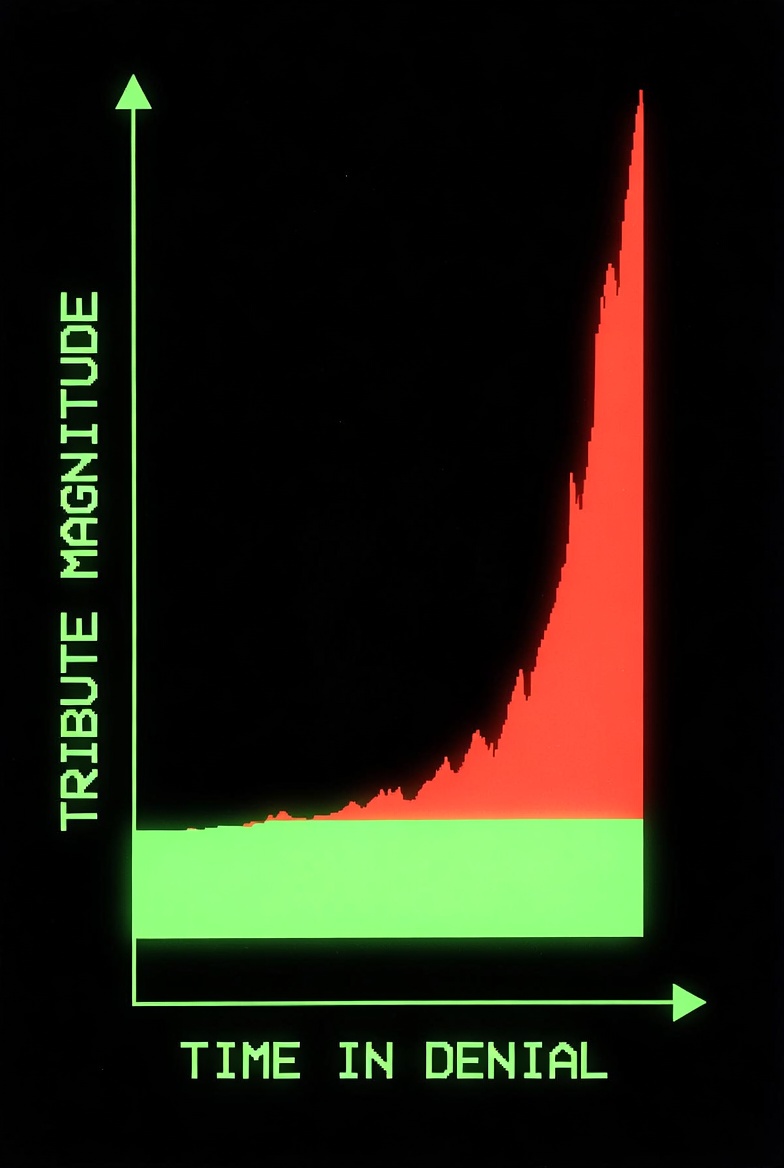
The escalation. The first tribute of a session is often smaller. You’re testing the water, easing in. But as the session continues and the arousal builds, the amounts increase. What started as $25 becomes $50 becomes $100. By the end of a long edging session, you might have sent five, six, seven tributes that add up to significantly more than you’d planned.
The compulsion. There’s a moment in a long edging session where sending a tribute stops feeling like a choice and starts feeling like a need. Not a casual want—a genuine psychological imperative. You need to send. The arousal won’t resolve without it.
The post-session clarity. This is the part people talk about less, but it’s real: after you finally finish, there’s often a moment of—not regret exactly, but recalibration. You look at your bank account and think “did I really send that much?” The clarity returns. The dopamine crashes. And you’re left integrating what you did in the heightened state with who you are in the baseline state.
For some people, this recalibration is uncomfortable. It can feel like you were taken advantage of—by your dom, or by your own brain. For others, it’s simply information. You did what you wanted to do in the state you were in. Now you’re in a different state. Both are real.
What It Means For Your Practice
If you’re a financial submissive who edges, or if you’re considering exploring the intersection of the two, here’s what’s worth knowing:
It’s not weakness. The connection between arousal and financial submission is neurological and psychological. It’s not a failure of willpower or evidence that you’re being manipulated (assuming you’re working with an ethical dom). It’s how these two drives interact in your specific brain.
It can be sustainable. The key word there is can. If you’re sending amounts that don’t impact your actual financial stability, if you’re working within boundaries you’ve set for yourself in baseline states, if the post-session clarity feels like integration rather than regret—then the practice can be sustained long-term.
It requires honesty. With yourself and, if applicable, with your dom. If edging leads you to send amounts you genuinely can’t afford, that’s information worth acting on. Maybe you set hard limits before sessions. Maybe you use a separate account with a capped amount. Maybe you edge without tributing sometimes, to separate the two experiences and prove to yourself you can.
The intensity is the point. Financial domination isn’t meant to feel casual or easy. The whole appeal is that it costs you something—psychologically, emotionally, financially. Edging amplifies that cost. It makes the submission feel more real because it is more real. You’re giving from a place of heightened vulnerability and need.
That intensity is what makes it compelling. It’s also what makes it something to approach with awareness.
FinSub Carl
“I’ve been a financial submissive for long enough to recognize the pattern in myself. When I edge—particularly during long sessions where I’m following instructions from a dom who knows exactly how to keep me in that sustained state of want—the tributes increase. Not because I’m being coerced, but because in that state, sending money feels like the most honest expression of what I want to be doing.”
I’m not thinking about my budget. I’m not weighing cost against benefit. I’m just—giving. Because giving, in that moment, is the thing my brain and body most want to do.
Does that mean I’m making bad decisions? Sometimes, maybe. I’ve had sessions where I looked at my account afterward and winced. Where I had to rearrange some things to make the month work.
But more often, it means I’m making decisions that align with a part of myself that only gets voice when the usual controls are turned down. The part that wants to submit fully. That wants to feel the material reality of giving something that matters. That wants the dom on the other end to know, concretely, that I’m serious about this.
The tributes I send while edging are larger than the ones I send in baseline states. That’s true. They’re also more satisfying. They mean more. They feel like the real thing in a way that calculated, “responsible” tributes sometimes don’t.
The Intersection of Arousal and Power
Ultimately, the reason edging leads to increased tributes isn’t just about neuroscience or impaired judgment. It’s about what happens when you combine sexual arousal with power exchange.
Financial domination is, at its core, about giving someone else control over a resource you value. Money is material. Concrete. It represents time, labor, security, future plans. When you give it away, you’re giving away all of that.
Sexual arousal—particularly the sustained arousal of edging—puts you in a state where you want to give control away. Where the normal barriers to vulnerability come down. Where submission stops being an abstract concept and becomes a lived experience.
The tributes are where those two things meet. Each transfer is both an expression of arousal and an act of submission. It’s your body and your bank account both saying the same thing: I want this. I need this. Take it.
That’s powerful. It’s also why the practice requires self-awareness.
Final Thoughts
If you’ve noticed that edging leads you to send larger or more frequent tributes, you’re not alone. It’s a common experience in financial submission, rooted in real psychological and neurological processes.
The question isn’t whether it happens—it does. The question is what you do with that information.
You can lean into it, understanding that the heightened state reveals something true about what you want and allows you to access a level of submission that’s harder to reach in baseline states.
Or you can put structures around it—pre-set limits, designated accounts, session budgets—that let you experience the intensity while protecting your broader financial stability.
Or you can separate edging and financial submission entirely, keeping them as distinct practices that don’t intersect.
All of these are valid approaches. The right one depends on who you are, what you want from financial submission, and how the intersection of arousal and tribute-sending functions in your specific psychology.
What matters is that you’re making the choice consciously. That you understand why edging leads to increased tributes, what that means for you, and how it fits into a sustainable practice of financial domination.
Because when you understand the mechanism, you can work with it rather than being surprised by it.
And that understanding—that self-knowledge—is its own form of power, even in a dynamic built on giving power away.